Tell us about your goals, challenges, and vision. Our experts will help you identify the right digital strategy to grow your business and achieve measurable results.
Posted By
Riya
Posted Date
13 July, 2026
Share:
Think about the last time a brand stopped you mid-scroll. Chances are it was not a perfectly polished AI-generated ad with flawless graphics. It was probably something that felt familiar. A logo you remembered from childhood. A jingle you had not heard in twenty years. A product you thought was gone forever, suddenly back on the shelf.
That feeling has a name. And in 2026, it has become one of the most powerful strategies in modern marketing.
Welcome to the era of nostalgia marketing
What Is Nostalgia Marketing?
Nostalgia marketing is the practice of using elements from the past, old logos, discontinued products, retro jingles, vintage packaging, or cultural references from earlier decades, to create an emotional connection with today’s audience.
It works because nostalgia triggers something deeper than logic. When a consumer sees or hears something familiar from their past, their brain releases dopamine, the same chemical associated with pleasure and reward. That emotional response happens before any rational evaluation kicks in. People feel good first and think second.
Research shows that nostalgic ads can lift sales by up to 23%, and 75% of consumers say they are more likely to buy when ads evoke nostalgia. These are not small numbers, they represent a genuine shift in how purchasing decisions are made.
Why It Is Working So Well in 2026
The world in 2026 is oversaturated with content. Every feed, every platform, every inbox is flooded with AI-generated posts that look polished but feel empty. Consumers are exhausted by perfection.
Nostalgia is the antidote
In an AI-saturated environment, brands that activate shared memories stand out and become truly memorable. Nostalgia does not sell products. It sells connection and meaning.
There is also a psychological timing element at play. Peak nostalgia typically hits around 20 to 30 years after the original experience. In 2026, that puts the sweet spot squarely in the late 1990s and early 2000s. This explains why Y2K aesthetics, early-2000s fashion references, and millennium-era pop culture are dominating marketing campaigns right now.
Even more interesting is a phenomenon researchers are now calling ‘nowstalgia.’ Searches related to 2016 have grown by more than 450% in recent months, driving the return of aesthetics, music, and visual codes from that era. Nostalgia cycles are accelerating, what felt recent just years ago is already being treated as a cherished memory.
Real Brands Doing It Right
This is not a theory. Some of the world’s most recognised brands are actively mining their archives and seeing real results.
Burger King
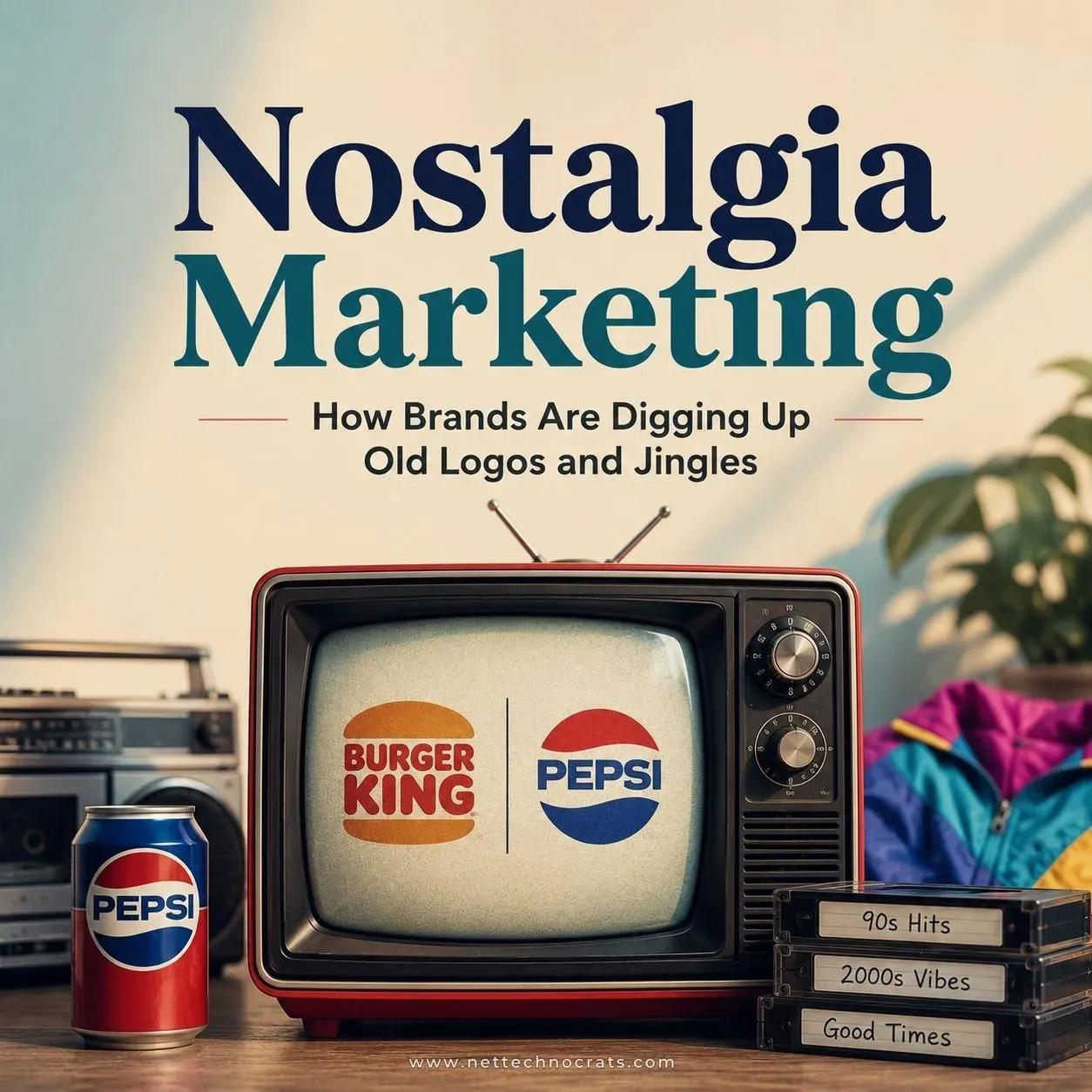
Burger King is perhaps the clearest example. Its 2021 rebrand adopted a retro-inspired logo based on its 1969-1999 design, applying it across a completely modern digital and packaging system. The result felt both familiar and fresh, which is the balance that separates effective nostalgia from pure imitation. The brand also brought back its 90s Cini-Minis and vintage packaging, triggering a wave of social media sharing that no paid campaign could have manufactured.
Pepsi
Pepsi took a similar approach. Its 2023 logo redesign brought back the bold wave and black wordmark from its iconic 90s branding, making the brand feel both timeless and current. The campaign successfully combined a modern identity refresh with a deeply familiar visual memory, proof that you do not always need a new product to create a fresh moment.
Nike and Adidas
Nike remains the world’s top apparel brand by revenue, yet it still mines its own archive. The Total 90 football boot silhouette returned in March 2026 with colourways nodding to early 2000s legends like Ronaldinho and Edgar Davids, triggering genuine excitement across social platforms from fans who remembered those boots on the pitch in their childhood.
McDonald’s
McDonald’s turned a simple promotion into a cultural moment. The brand released limited-edition adult Happy Meals in collaboration with streetwear brand Cactus Plant Flea Market, complete with classic cardboard boxes and redesigned childhood toys. Overnight, millennials who grew up with Happy Meals were lining up at drive-thrus, sharing unboxing videos, and selling the toys online. It proved how powerful nostalgia can be when you give adults permission to relive a childhood experience with a modern, playful twist.
Spotify
Spotify did it without bringing back a single physical product. Its Time Capsule playlists offered users a curated mix of songs from their teenage years, personalisation powered by data, but dressed in pure emotion. The result was millions of users flooding social media with posts about how accurate or surprisingly emotional their playlists felt.
The Numbers That Prove It Works
The results behind nostalgia campaigns are not just anecdotal. The data is clear and consistent.
More than 50% of US adults are likely to make a purchase when something makes them feel nostalgic.
Brands can increase engagement by up to 60% by leveraging nostalgia.
Consumers are willing to pay up to 10 to 15% more for products that evoke nostalgic feelings.
Retro product re-releases drove a 24% lift in repeat purchases.
Nostalgic ad elements improve ad recall by 39%..
TikTok nostalgia hashtags surged 130% year over year between 2024 and 2026.
81% of young consumers like it when brands bring back products and trends from their childhood
Perhaps most surprising is that Gen Z – who did not even experience the Y2K era firsthand — are actively drawn to its aesthetics and cultural references. Nostalgia is no longer about age. It is about emotional resonance.
How to Use Nostalgia Without Getting It Wrong
Nostalgia marketing is powerful, but it can also backfire if executed poorly. There is a term for this: nostalgia washing. It describes campaigns that slap a retro filter on a product without any genuine thought or connection to the audience’s real memories.
Here is what separates campaigns that work from the ones that fall flat:
Be specific, not vague. The most effective nostalgia triggers are precise — a particular jingle, a discontinued product flavour, a specific colour palette from a specific decade. A generic ‘remember the good old days’ message connects with no one.
Bridge the past to the present. The strongest campaigns use a memory from the past to frame something happening right now. The memory opens the door. The modern product walks through it.
Do not let nostalgia cover up real problems. A beloved jingle cannot save a failing product or a poor customer experience. Nostalgia builds emotional connection — but that connection must lead somewhere genuinely worth going.
Know your audience’s memory, not yours. The era that means something to your marketing team may be completely irrelevant to your customers. Build campaigns around what the audience remembers.
What This Means for Your Brand
You do not need to be a century-old company with a rich archive to use nostalgia marketing. Newer brands can tap into shared cultural moments, pop culture references, or even recent nostalgia from just a few years ago.
The core principle remains the same for every business: people connect with what feels familiar and human. In a world increasingly dominated by automation and AI-generated content, anything that genuinely feels warm, real, and emotionally grounded has a competitive advantage that is very difficult to manufacture.
The brands winning in 2026 are not stumbling into nostalgia by accident. They are deliberately identifying one memory from their audience’s past, connecting it to a present-day product or campaign, and delivering it with enough authenticity that consumers feel seen rather than sold to.
That is the real power of nostalgia marketing. It is not about living in the past. It is about using the past to build something people actually want to be part of today.
Want to build a marketing strategy that genuinely connects with your audience?
audience?
At Nettechnocrats, we help businesses develop digital marketing strategies that build real emotional connection – not just reach.