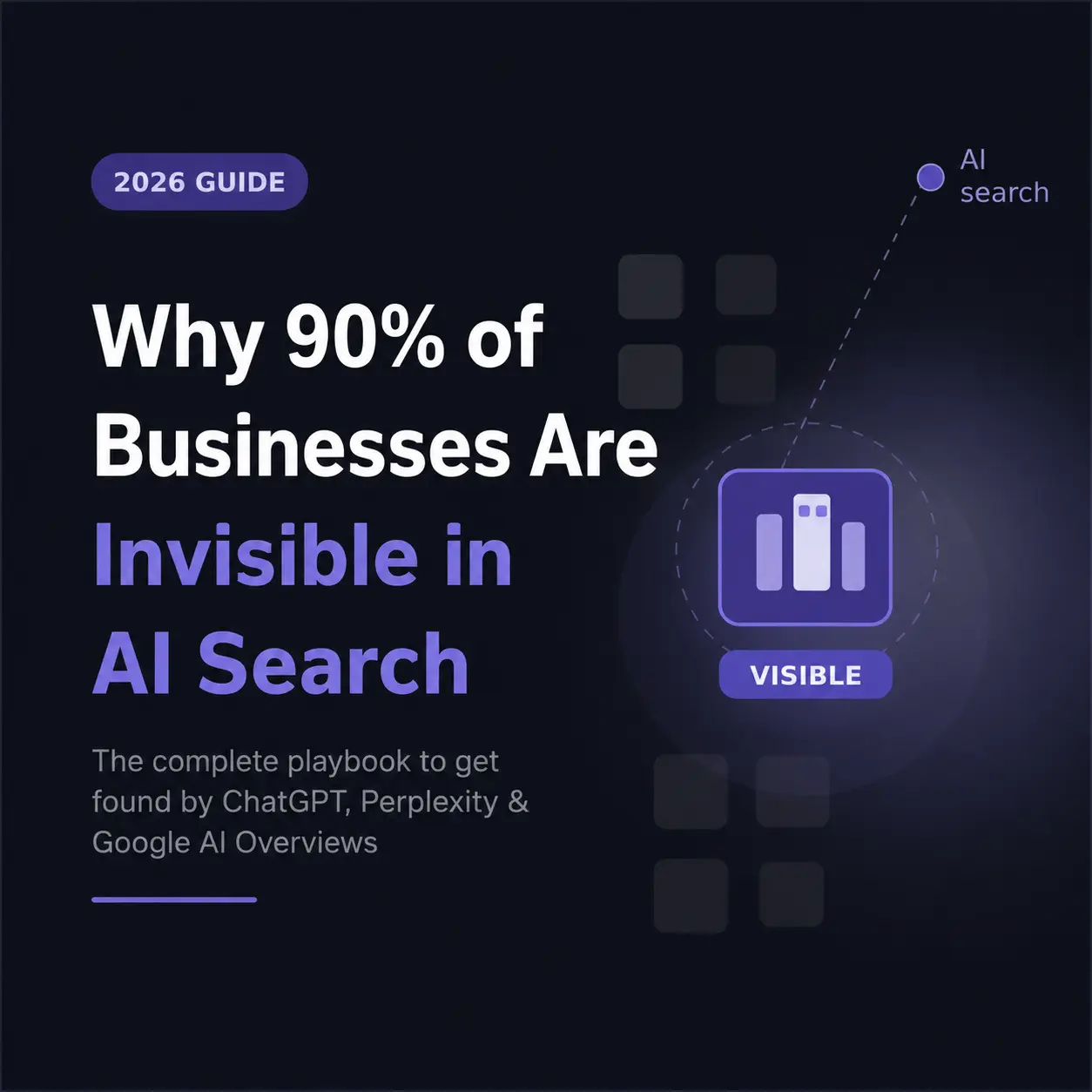
Why 90% of Businesses Are Invisible in AI Search (2026 Guide)
Why 90% of Businesses Are Invisible in AI Search (2026 Guide)
Posted By
Nettech
Posted Date
12 June, 2026
Share:
You built the site, did the blog posts, maybe paid someone to “do the SEO.” And yet, when anyone searches ChatGPT, Perplexity, or Google AI Overviews for a recommendation in your industry, you’re not there.
You are not alone. 90% of businesses are completely invisible in AI-powered search, and most don’t even know why. It’s not bad luck. It is a structural problem, and most businesses don’t even realise it’s happening to them. This guide describes what’s blocking your business from appearing in AI search, how to rank in AI search, how AI search works, an AI SEO strategy for 2026, and what you need to do today to appear where your customers are already searching.
The Problem That Nobody Is Talking About
Here’s a statistic that should worry you. By the beginning of 2026, the percentage of the top-ranking Google pages that are actually cited by sources used by AI platforms has fallen from 70% to less than 20%.
Read it again. Google rankings no longer guarantee that you’ll appear in AI answers. These are two different games, and at the moment, most companies are playing only one of them, the old one.
Now, depending on the kind of search, you’ll find AI Overviews appearing in between 20% and 40% of all Google searches. ChatGPT has hundreds of millions of users every week. Perplexity handles about 780 million queries per month. And now, 35% of US consumers use AI in the product discovery phase, before they even type into a search bar.
If your business is not appearing in those AI responses, you do not exist to those customers. Not in the “hard to find” sort of way, in the sense of the real invisible.
The businesses that know what has changed and act on it will pick up the customers the invisible ones are losing every day.
How AI Search Works Actually
The only way to fix this problem is to figure out what’s really happening when somebody asks ChatGPT or Perplexity a question about your industry.
Most optimize for AI search engines use a process called Retrieval-Augmented Generation (RAG). It has two different phases.
Stage 1 Retrieval
The AI is not just regurgitating something from its training data. It queries an index, either Google’s existing index of the web (for AI Overviews) or a real-time crawler (Perplexity does this), and pulls back a set of candidate documents. These are the pages it uses to look.
Stage 2 Generation
A large language model reads the retrieved documents, synthesises the information, and writes a response. It usually lists two to five sources it found most useful and authoritative.
Your content must pass both phases. It has to be findable enough to be found in the first place and structured and authoritative enough to be chosen as a cited source.
Most companies fail at Stage 1 before they even reach Stage 2.
How AI Actually Breaks Down Your Customer’s Question
When someone asks an AI, “What’s the best IT support company for small businesses in Florida?”, the AI doesn’t search for that exact phrase. It breaks down the question into smaller sub-queries, such as “IT support small business features,” “IT support pricing comparison,” and “IT support company reliability,” and searches for each of them separately.
It is called query fan-out, and it means that a single well-optimized page on your site probably isn’t enough. You need content that addresses all the sub-queries that may arise from your target customer’s question.
The 7 Reasons Your Business Is Not Showing Up in AI Search
1. AI Crawlers Are Blocked From Your Site
Many websites have robots.txt files that block AI bots without the site owner knowing. If you are a Cloudflare user, you probably noticed that its default setting recently changed to automatically block AI crawlers. Your site may have gone dark to ChatGPT and Perplexity without you changing a single setting.
Check your server logs for the user agent “ChatGPT-User.” If it isn’t, then AI bots aren’t coming to your site. Fix your robots up.txt. Activate GPTBot, ClaudeBot, PerplexityBot, & Google-Extended.
No access to crawl is no access to cite.
2. Your Content Doesn’t Answer Questions Directly
AI systems want pages with answers that can be directly extracted. They like content that answers a question, states a fact, and gets to the point quickly.
Most business websites are written to impress, not to answer questions. Core values are listed on the “About Us” page. Features are in the services page. The blog posts are 500-word opinion pieces that never take a clear side.
AI systems go straight to looking for content that says, “Here is the answer to your question.” If your pages don’t do that, you won’t get cited.
3. You Have No Third-Party Mentions
It is where the difference between traditional SEO thinking and GEO thinking is most evident: your own website is not your best asset for AI visibility.
AI platforms tend to trust third-party sources more than brands’ own information, including industry publications, review sites, news coverage, and professional directories. That makes sense logically. If 10 independent sources are saying the same thing about you as a company, it’s probably true.” Just marketing, if your site says so.
Review-style content, guides published on authoritative third-party domains, and press mentions carry significant weight with AI platforms when formulating their answers. If your brand only exists on your own website, AI search doesn’t know you.
4. Your Content Isn’t Well Enough for Extraction
AI systems want a clear question, a clear answer, or a heading and concrete supporting details.
AI can’t easily identify the citable elements in the walls of unstructured paragraph text. When a page doesn’t have schema markup, the AI doesn’t know what it’s looking at. Something more extractable is passed over in favor of content that puts the key point in the fifth paragraph instead of up front.
Proper schema markup on your content will get you 30% to 40% more AI-generated answers. That’s not a marginal gain, that’s the difference between being there and not being there”.
5. You’re Not Demonstrating Real Expertise
Both Google and AI platforms are putting a lot of focus on what is often called E-E-A-T, which is Experience, Expertise, Authoritativeness, and Trustworthiness, in 2026. But the “Experience” part, the first E, is newer and increasing in importance.
AI systems like good content that shows first-hand knowledge. Not just “here are five tips for X,” but “here’s what we saw when we X’d with 12 different clients. Real data, real numbers, named experts, case studies, all of these add up to content coming from someone who really knows what they’re talking about, and not just someone who aggregated other people’s content.
AI does not cite thin content with no original insight. It’s just background noise for context, no more.
6. Your Content Is Stale
AI platforms, and especially Perplexity, which is built on real-time search, have a strong preference for fresh content. Research shows that content cited by AI is, on average, about 25% fresher than content that ranks well in traditional search.
A 2022 blog post about digital marketing trends will not be referenced in a 2026 answer. If an article is updated with current statistics and current examples in Q1 2026, it has a real chance.
If you haven’t meaningfully updated your site in months, you’re already behind.
7. You’re Optimizing for Keywords Instead of Questions
SEO made everyone think in keywords. Use the right phrases at the right density, and Google will rank you higher.
That’s not how AI searches. It works on semantic relevance, meaning, does your content answer the question and the purpose behind the query, not just the words used?
AI citation studies do worse with keyword stuffing, which has already been losing effectiveness with Google, than with content that actually answers questions in natural language. The AI can distinguish.
How to Rank in AI Search (GEO): What Actually Works in 2026
Generative Engine Optimization (GEO) is also known as AI SEO or Large Language Model Optimization (LLMO). It is the act of optimizing for AI search. The industry hasn’t landed on a single term yet. They all mean the same thing: making your content the place AI platforms go to get a citation.
It is what really makes the difference.
Build Topical Authority, Not Just Pages
AI platforms like sources that go deep on a topic, not sources that have one page on fifty different topics. If you have a digital services business, that means publishing a cluster of genuinely useful content around each service area, not one services page and a couple of blog posts.
It’s known as a topic cluster approach. One pillar page provides complete coverage of a broad topic. Supporting pages detail specific subtopics. They all hook up with one another. The signal this sends to AI platforms is that this source actually knows this subject.
Write Content That Passes the “Extract Test”
Before you post anything, ask yourself this: if an AI were to pull one passage from this page to cite in an answer, what would that passage be? If you can’t see it, neither can the AI.
Every important page should have at least one direct, self-contained passage that answers a specific question. Put that in early. How did the older woman get the money? Respond in the first two sentences. Add supporting detail after:
This setup works for both AI citations and Google’s featured snippets. You’re optimizing both channels simultaneously.
Your Name Into Trusted Third-Party Sources
It is slower work, but it compounds. You want your business name, your expertise, and your unique value proposition consistently mentioned across the sources AI platforms already trust, like industry publications, local business directories, review platforms (Google Business Profile, Trustpilot), guest posts on established sites, and local news coverage, where relevant.
The goal is what researchers term consistent naming and framing across independent sources. If multiple sources tell the same story about your business, AI systems get a better understanding of what you do and who you serve, and are more likely to recommend you when the topic arises.
Implement Schema Markup
Schema markup is structured data you add to your website’s code to tell AI crawlers exactly what type of content they are encountering. The FAQ schema tells the AI these are questions and answers. The LocalBusiness schema gives your business name, address, and service area. Review schema indicates trustworthiness.
It is easy to implement, and the gains in visibility are huge. Test your implementation using Google’s Rich Results Test.
Keep Content Fresh
Put a reminder in your calendar to update your most important pages quarterly. Add new stats, update examples, refresh stale dates, and remove anything that’s no longer true.
It is especially true for service pages and comparison content, the content types most commonly cited in AI responses.
How the Different AI Platforms Pick Their Sources
Knowing each platform helps you figure out where to prioritise.
Google AI Overviews
It leverages Google’s existing search index, so good traditional SEO performance translates directly. Google’s top results become candidates for inclusion in AI Overviews. Schema markup and clear content structure go a long way to improving your selection rates from that candidate pool.
ChatGPT Search
Search › The search combines answers from live web sources and includes citations inline. Wikipedia provides a disproportionate share of its factual citations, followed by established news and educational sources. For businesses, this means that mentions by third parties on authoritative sites carry more weight than your own website.
Perplexity AI
It is the most citation-transparent of the major platforms and tends to favor recent, well-sourced content. Indeed, it has high conversion rates for SaaS and service businesses, according to its answers. If you work in B2B services, Perplexity visibility should be on your priority list.
Google Gemini
It’s built right into Google’s search infrastructure. If Google SEO is doing well, you’ll usually see strong Gemini visibility. It’s the pairing with the highest correlation of any.
Claude (Anthropic)
Claude likes to paraphrase rather than quote, and likes content that is well-structured and logically organized. Apple’s integration of Claude into Safari is likely to significantly expand the impact of its content discovery.
Your AI SEO Strategy for 2026: What to Do, Week by Week
If your business is invisible in AI search today, here are the strategies you should follow in month 1.
Week 1
Check your robots.txt file and your server logs. Make your website accessible to AI crawlers. Let the big AI bots. It is the floor. If you are blocking crawlers, nothing else matters.
Week 2
Find the 5-10 questions your target customers are actually asking before buying from a business like yours. No keyword phrases, real questions. How much does IT support cost for a 20-person company? What’s the difference between managed IT and break-fix support? These are your content goals.
Week 3
Review your existing content pages. Do any of them provide direct answers to those questions? If not, change them to do so. Add clear question-based headers. The answer should be the first two sentences of each section. Add the FAQ schema when it naturally fits into the page.
Week 4
Do monitor the changes and outcomes at the initial stage.
Month 2
Start building a third-party presence. If you have not, claim and complete your Google Business Profile. List your business in three to five relevant industry directories. Write a guest piece for a local or industry publication on something you are passionate about.
Month 3 onward
Regularly publish new content. If you can do one really useful question-answering piece a month, that beats six thin pieces. Even a client survey with ten responses counts as original data that AI platforms can cite.
How to know if it’s working. You can’t measure AI visibility the same way you measure traditional SEO. No grading to follow. Here’s what to look at instead.
How to Measure If It’s Working
AI visibility isn’t measured the same way as traditional SEO. There’s no ranking position to track. Here’s what to look at instead.
Manual citation testing
Every month, ask ten to fifteen questions that your ideal customer would ask across ChatGPT, Perplexity, and Google AI Overviews. Document if your business appears and how it is described, and which competitors appear instead. It takes an hour and gives you a more useful signal than any tool on the market today.
AI referral traffic in Google Analytics 4
Set up tracking for traffic arriving from ChatGPT.com, Perplexity.ai, and similar sources. This traffic is growing fast, with sessions referred by AI up 527% year-over-year in the first five months of 2025, but it still accounts for only a small percentage of overall organic traffic for most companies. Traditional SEO? Don’t forget. Google sends 345x more traffic than the top AI platforms combined.
Brand mention monitoring
Create Google Alerts for your company name. More third-party mentions signal to AI platforms that they can paint a picture of your brand.
The Window Is Still Open
47% of brands don’t have a deliberate AI SEO strategy 2026. The reality is that’s not a crisis, it’s an opportunity.
The ones that get it now will be the ones that the AI platforms have a firm grasp of by the time all of their competitors finally start to notice. Citation authority builds over time, much like domain authority did in the early days of SEO.
If your IT or digital services business isn’t showing up in AI search, you’re losing customers to those that are. Your next customer is already using AI to query your industry. The only question is whether your name is in the reply.
Frequently Asked Questions (FAQ)
Why my website is not showing in ChatGPT? The most common reasons are that your robots.txt file is blocking AI crawlers, your content is not providing direct answers to user questions, or your business is not being mentioned by third parties that AI platforms can use for cross-referencing. First, check if ChatGPT’s crawler (GPTBot) can visit your site.
How to appear in Google SGE? Google SGE (Search Generative Experience) was rebranded to AI Overviews in 2024, same system, different name. It’s built on Google’s existing search index. Candidates are pages that appear in Google’s top results for relevant queries. From that pool, pages that have a clear, direct-answer structure, FAQ schema markup, and strong E-E-A-T signals are most often selected. If you’re doing well in rankings but not showing in AI Overviews, the problem is usually content structure, not authority.
What is AI search optimization? AI search optimization (aka GEO, Generative Engine Optimization, or LLMO) is the process of optimizing your content and brand authority to be cited or recommended by AI-powered search platforms (like ChatGPT, Perplexity, Google AI Overviews, Gemini, and more) in their answers. It builds on the core principles of traditional SEO and adds specific requirements for content structure, third-party presence, and schema markup.
What’s the difference between AI SEO and regular SEO? The traditional way of doing SEO is to optimize to get a rank in a list of links. AI SEO (GEO) Optimize for inclusion in the synthesized answer. A page can be #1 in Google but never show up in ChatGPT if it doesn’t have the structural elements AI platforms are looking for. The two disciplines share common core foundations, quality content, technical accessibility, and earned authority, but GEO also has requirements that traditional SEO does not address.
How long does it take to show up in AI search results? If a trusted publication mentions your business, third-party mentions can impact AI responses in as little as weeks. You can see results for AI Overviews in one to two months from improving your own content structure and schema, as Google recrawls frequently. Most businesses need 3 to 6 months to build the topical authority that leads to consistent AI citations.
Does AI search optimization help with Google rankings, too? Yes, a lot of Google’s traditional algorithm also benefits practices that support AI visibility, direct-answer content structure, schema markup, earned third-party mentions, and topical depth. GEO is not a separate SEO track. It’s an evolution of it.
Conclusion
AI search is rapidly changing how customers discover businesses online. Ranking on Google alone is no longer enough for your business also needs to be visible in AI-generated answers on platforms like ChatGPT, Perplexity, Google AI Overviews, and Gemini.
By making your content AI-friendly, implementing schema markup, building topical authority, earning trusted third-party mentions, and keeping your content updated, you can significantly improve your chances of being cited by AI platforms.
The businesses that adapt to AI SEO today will gain a competitive advantage tomorrow. The question is no longer whether your customers are using AI to find solutions, but whether your business is appearing in the answers.
Why 90% of Businesses Are Invisible in AI Search (2026 Guide)
The VIP treatment here is legit. Great rewards and the customer support team is always helpful when I have questions. mxbetvip is the place to be.
dragonslotsonline,
07 July, 2026
The slot themes are amazing and the jackpot feels achievable. It is such an exciting atmosphere. You should definitely visit dragonslotsonline.
mmgb168,
07 July, 2026
The bonuses here are legit and not just bait. I’ve had a great run this month and the customer support is always on point. Love mmgb168.
betwayapuestas,
07 July, 2026
The odds here are some of the best I have seen in a while. Everything is transparent and the layout is very intuitive. Big fan of betwayapuestas
winbetbgapp,
07 July, 2026
Using the app makes a huge difference. I can place my bets on the go without any glitches. Such a convenient tool from winbetbgapp
winbddownloadappapk,
07 July, 2026
The APK installation was super straightforward. I was up and running in less than two minutes. Great job by winbddownloadappapk
phonejoyapp,
09 September, 2026
Really impressed with the graphics and the overall speed of the app. Definitely check out phonejoyapp for a quality experience.
32jililoginregisteronline,
09 September, 2026
Registering my account took less than a minute. It is great to see a platform that values the users time. Sign up at 32jililoginregisteronline today.
bd6777bat,
09 September, 2026
Really impressive variety of games available here. I spent hours exploring different options and everything works perfectly. bd6777bat is definitely my new go to spot.
52betwinapp,
09 September, 2026
The graphics are stunning and the gameplay is fluid. It is honestly one of the most polished apps I have used in a long time. Love 52betwinapp
iddewaslot88,
09 September, 2026
The slots here are actually fair and the graphics are stunning. I spend way too much time here because it is so addictive. Try iddewaslot88
royalsensaslot,
09 September, 2026
The graphics on this site are stunning and the gameplay is very intuitive. I hit a decent streak yesterday and the withdrawal was seamless. Love royalsensaslot so far!
bdkg999apk,
09 September, 2026
Honestly, the graphics and the response time on this app are impressive. It really adds a level of excitement to the whole experience. Definitely give bdkg999apk a shot.
okbeylogin,
09 September, 2026
Quick and easy login process. I hate it when sites make it hard to enter your account, but okbeylogin keeps it simple and efficient.
imbagacorlogin,
09 September, 2026
Top notch service and the bonuses are actually decent. I’m really enjoying my time on imbagacorlogin so far.
kkk777loginapp,
09 September, 2026
The app version is just brilliant. I can play anywhere and the connection is stable as a rock. kkk777loginapp is a game changer for mobile players.
bbjlslots,
10 October, 2026
Alright folks, if you’re looking for some sweet slots online, bbjlslots is where it’s at! The games are pretty good, and I’ve had some decent luck there. Give it a shot, you might just win big! bbjlslots
bdfk77,
10 October, 2026
The bonuses they offer are actually decent and not just clickbait. I had a blast playing on bdfk77 last night!
bdbb444app,
10 October, 2026
Really liking the rewards system on this app. It keeps things exciting and the prizes are actually attainable. bdbb444app is my new favorite.
ph29ph,
10 October, 2026
A very friendly community and a fair gaming environment. I’ve shared this with a few friends and we are all enjoying the experience. ph29ph
phtaya713,
10 October, 2026
The community is great and the promotions are always fresh. It keeps things interesting every time I log in. phtaya713 is a winner.
bdnagod777,
10 October, 2026
Welcome to my new favorite place for evening entertainment. The bonus offers actually feel worth claiming and the withdrawal process never leaves me waiting around. I really appreciate how secure everything feels while playing. Give this site a try and you will see why I keep coming back. bdnagod777
phfierylogin,
10 October, 2026
The energy on this site is awesome. The games are exciting and the promotions are always updated. Go to phfierylogin























Comments (24)
Blake319,
06 June, 2026https://shorturl.fm/KckqQ
mxbetvip,
07 July, 2026The VIP treatment here is legit. Great rewards and the customer support team is always helpful when I have questions. mxbetvip is the place to be.
dragonslotsonline,
07 July, 2026The slot themes are amazing and the jackpot feels achievable. It is such an exciting atmosphere. You should definitely visit dragonslotsonline.
mmgb168,
07 July, 2026The bonuses here are legit and not just bait. I’ve had a great run this month and the customer support is always on point. Love mmgb168.
betwayapuestas,
07 July, 2026The odds here are some of the best I have seen in a while. Everything is transparent and the layout is very intuitive. Big fan of betwayapuestas
winbetbgapp,
07 July, 2026Using the app makes a huge difference. I can place my bets on the go without any glitches. Such a convenient tool from winbetbgapp
winbddownloadappapk,
07 July, 2026The APK installation was super straightforward. I was up and running in less than two minutes. Great job by winbddownloadappapk
phonejoyapp,
09 September, 2026Really impressed with the graphics and the overall speed of the app. Definitely check out phonejoyapp for a quality experience.
32jililoginregisteronline,
09 September, 2026Registering my account took less than a minute. It is great to see a platform that values the users time. Sign up at 32jililoginregisteronline today.
bd6777bat,
09 September, 2026Really impressive variety of games available here. I spent hours exploring different options and everything works perfectly. bd6777bat is definitely my new go to spot.
52betwinapp,
09 September, 2026The graphics are stunning and the gameplay is fluid. It is honestly one of the most polished apps I have used in a long time. Love 52betwinapp
iddewaslot88,
09 September, 2026The slots here are actually fair and the graphics are stunning. I spend way too much time here because it is so addictive. Try iddewaslot88
royalsensaslot,
09 September, 2026The graphics on this site are stunning and the gameplay is very intuitive. I hit a decent streak yesterday and the withdrawal was seamless. Love royalsensaslot so far!
bdkg999apk,
09 September, 2026Honestly, the graphics and the response time on this app are impressive. It really adds a level of excitement to the whole experience. Definitely give bdkg999apk a shot.
okbeylogin,
09 September, 2026Quick and easy login process. I hate it when sites make it hard to enter your account, but okbeylogin keeps it simple and efficient.
imbagacorlogin,
09 September, 2026Top notch service and the bonuses are actually decent. I’m really enjoying my time on imbagacorlogin so far.
kkk777loginapp,
09 September, 2026The app version is just brilliant. I can play anywhere and the connection is stable as a rock. kkk777loginapp is a game changer for mobile players.
bbjlslots,
10 October, 2026Alright folks, if you’re looking for some sweet slots online, bbjlslots is where it’s at! The games are pretty good, and I’ve had some decent luck there. Give it a shot, you might just win big! bbjlslots
bdfk77,
10 October, 2026The bonuses they offer are actually decent and not just clickbait. I had a blast playing on bdfk77 last night!
bdbb444app,
10 October, 2026Really liking the rewards system on this app. It keeps things exciting and the prizes are actually attainable. bdbb444app is my new favorite.
ph29ph,
10 October, 2026A very friendly community and a fair gaming environment. I’ve shared this with a few friends and we are all enjoying the experience. ph29ph
phtaya713,
10 October, 2026The community is great and the promotions are always fresh. It keeps things interesting every time I log in. phtaya713 is a winner.
bdnagod777,
10 October, 2026Welcome to my new favorite place for evening entertainment. The bonus offers actually feel worth claiming and the withdrawal process never leaves me waiting around. I really appreciate how secure everything feels while playing. Give this site a try and you will see why I keep coming back. bdnagod777
phfierylogin,
10 October, 2026The energy on this site is awesome. The games are exciting and the promotions are always updated. Go to phfierylogin